05/03/2024
PRESS RELEASE: THE INF-ACT FOUNDATION AWARDS 3 MID-CAREER GRANTS
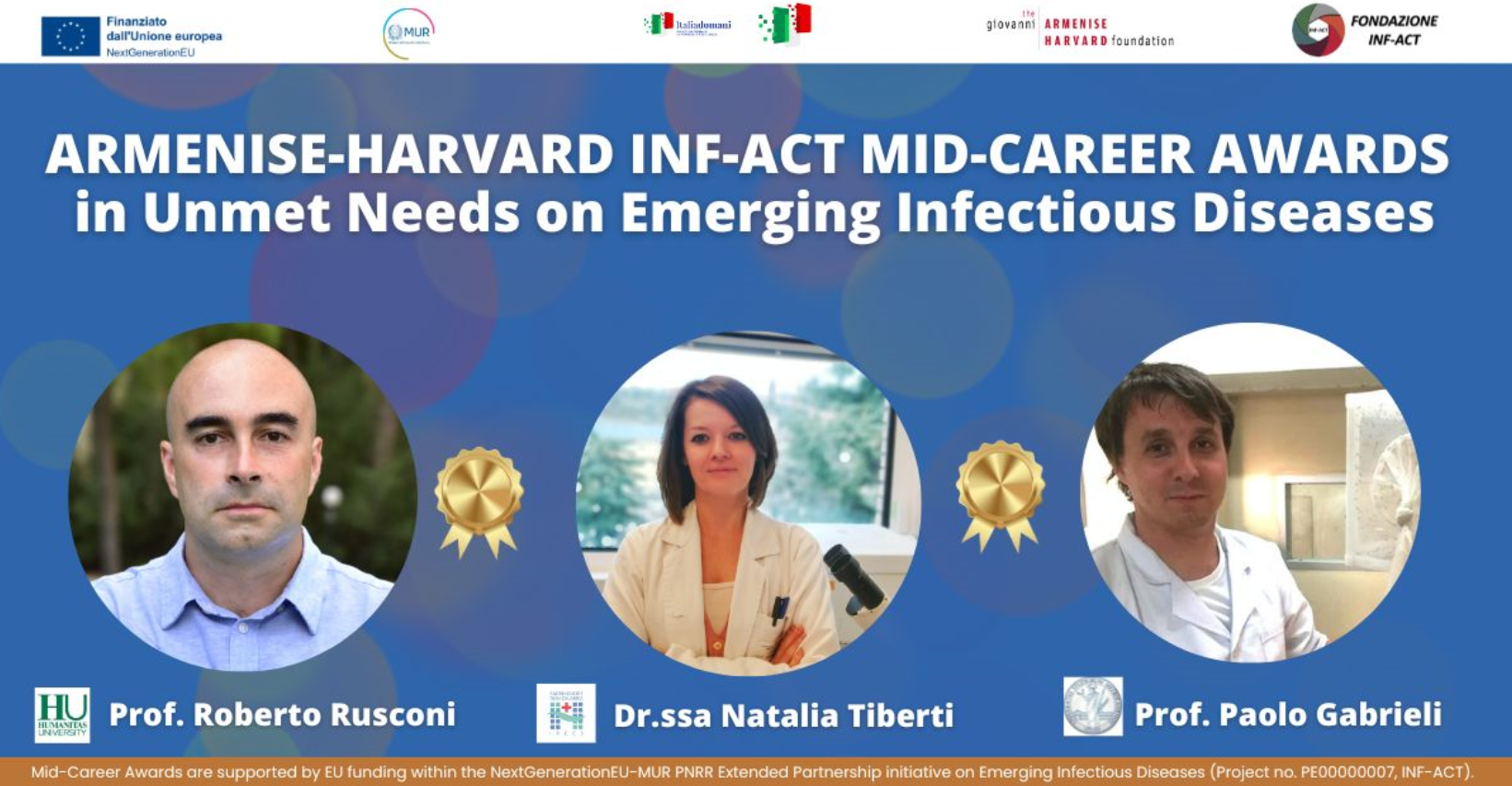
3 mid-career researchers will be able to continue studying emerging infectious diseases. Three winning projects, two foundations, one common goal: to advance the most promising research projects in the field of emerging infectious diseases.
Natalia Tiberti, who studies biomarkers at IRCCS Ospedale Sacro Cuore Don Calabria to contribute to the early diagnosis of acute fevers. Roberto Rusconi, who studies bacterial biofilms at IRCCS Istituto Clinico Humanitas to understand how these biofilms form and why they resist antibiotics. Paolo Gabrieli, who is developing new eco-friendly mosquito control techniques at the University of Milan.
Each has been awarded €150,000 funded by the INF-ACT Foundation, in collaboration with the Armenise-Harvard Foundation. This grant is unique because, to access the funding, applicants affiliated with one of the 25 partners of the INF-ACT Consortium had to have been active for at least 5 but fewer than 12 years.
A matter of funding, not quality
The three research projects were selected through the rigorous procedures of the Armenise-Harvard Foundation. They were chosen because they share an innovative approach to infectious disease research, aimed at better managing the emergence of potential new epidemics.
"We are extremely pleased because we received applications from researchers involved in the various aspects required to address emerging infectious diseases through innovative, cross-cutting, and multidisciplinary approaches. These funds represent an additional allocation of resources for research activities within the PNRR project managed by the INF-ACT Foundation, in response to an internal call that we specifically wished to dedicate to mid-career researchers. The three awarded grants will ensure that these accomplished scientists can continue their studies and explore the potential of modern scientific research, where human health is interconnected with animal and environmental health (One Health)," states Federico Forneris, President of the INF-ACT Foundation.
"The scarcity of funding dedicated to those halfway through their professional career often puts established paths at risk, compromising the ability to bring the investments made during a lab's startup phase to fruition. Above all, it risks thwarting the achievement of scientific discoveries. The experience of over 20 years at the Armenise-Harvard Foundation is emblematic: through our Career Development Award (CDA) program, we have supported the research of more than 30 scientists in Italy who, in turn, have raised nearly €100 million in funding, publishing more than 1,000 peer-reviewed papers with an average H-index of 26 and over 4,300 average citations. Despite this, however, our researchers also suffer from this unacceptable situation," says Elisabetta Vitali, Director of Italian Programs at the Armenise-Harvard Foundation.
THE WINNERS
Natalia Tiberti - IRCCS Don Calabria Hospital
The funded project aims to investigate new biomarkers to contribute to the early diagnosis of acute fevers caused by arboviruses, such as the West Nile virus and Dengue virus. These biomarkers will make it possible to improve the management of febrile patients, contribute to controlling potential outbreaks caused by imported arboviruses, monitor the epidemiology of these infections in our territory more accurately, and prevent the inappropriate use of antibiotics.
BIOGRAPHY
Born in Parma, after earning her Bachelor's degree in Biotechnology and her Master's degree in Medical Biotechnology, she began her research journey in infectious and tropical diseases by obtaining her Ph.D. at the University of Geneva (Switzerland) under the supervision of Prof. Jean-Charles Sanchez. She subsequently refined her skills as a post-doctoral researcher at the University of Sydney and the University of Technology Sydney (Australia) in Prof. Valery Combes' group. Since 2018, she has been an independent researcher in the Department of Infectious, Tropical Diseases, and Microbiology at IRCCS Ospedale Sacro Cuore Don Calabria (Negrar di Valpolicella, Verona), focusing on translational biomedical research with a special interest in studying biomarkers for infectious and tropical diseases, as well as the mechanisms of interaction between the human host and various types of infectious agents.
"The Armenise-Harvard INF-ACT Mid-Career Award represents vital support for my scientific career. Thanks to this funding, I will have the opportunity to expand my research group and employ innovative approaches in my studies, such as the analysis of extracellular vesicles—nanoparticles released by human cells in response to different pathogens that can carry biological information specific to the ongoing infection," concludes Natalia Tiberti, researcher at IRCCS Ospedale Sacro Cuore Don Calabria.
Roberto Rusconi - Humanitas University
The proposed project focuses on biofilms—bacterial communities protected by an extracellular matrix produced by the bacteria themselves. Biofilms represent one of the primary causes of persistent hospital-acquired infections, particularly associated with the use of biomedical devices. By focusing on the unique structures biofilms form under flow conditions (such as in catheters or stents), the project aims to understand how these biofilms develop and resist antibiotics, specifically investigating the role played by bacterial DNA released into the extracellular matrix. The goal is to discover new strategies to combat these resilient bacterial colonies, potentially leading to new infection control methods.
BIOGRAPHY
Holding a degree in Nuclear Engineering and a Ph.D. in Radiation Science and Technology from the Politecnico di Milano, he currently heads the Applied Physics, Biophysics, and Microfluidics Laboratory at Humanitas and serves as an Associate Professor at Humanitas University. Rusconi further enriched his academic background through post-doctoral research at both Harvard University and MIT, focusing his studies on areas ranging from colloidal suspensions to bacterial biofilms. His work sits at the intersection of soft matter physics, fluid mechanics, and biology.
"The Mid-Career Award is important because it fills a gap in the research funding landscape, offering crucial support to those in an intermediate stage between the more widespread opportunities for early-career researchers and senior-level recognition," explains Roberto Rusconi, Associate Professor at Humanitas University. "This award recognizes the unique position of scientists at this delicate stage of their professional path, allowing them to advance their research and consolidate their position—and that of their group—in the national and international academic community."
Paolo Gabrieli - University of Milan
The project aims to develop a new eco-friendly mosquito control technique by modifying their reproduction. Currently, mosquitoes are mostly controlled using insecticides, which are harmful to human health and the environment and are losing their efficacy. It is therefore necessary to develop environmentally friendly methods that offer speed and efficacy comparable to insecticides. One of the key traits of these insects, making them major vectors of human disease, is their ability to produce vast amounts of offspring in a short time. By limiting their reproductive capabilities, it is possible to reduce their numbers and control their populations.
Biography
Paolo Gabrieli is a Professor of Zoology in the Department of Biosciences at the University of Milan. Since graduating with a degree in biology, his primary research focus has been studying the biology of insects that transmit human and animal diseases—particularly mosquitoes—with the ultimate goal of developing new control systems for these insects and the diseases they transmit. His education and research training took place across several Italian universities (University of Pavia, Perugia, and Milan) as well as international institutions (Imperial College London, UK, and Harvard T.H. Chan School of Public Health in Boston, USA).
"The Armenise-Harvard INF-ACT Mid-Career Award allows me to consolidate my research group and implement the scientific approaches I envisioned to design new strategies for controlling mosquitoes and mosquito-borne diseases. It is also of vital importance for gathering new data and seeking further funding to achieve these goals," says Paolo Gabrieli of the University of Milan.
Image gallery